Kivas in Chaco Canyon
KIVAS
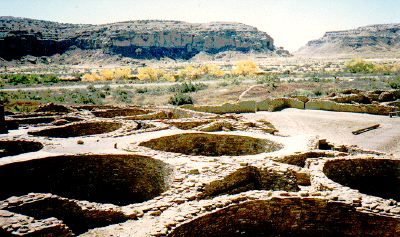
Nine of the 37 kivas
found in Pueblo Bonito.
Kiva means 'world below'. Small kivas such as these
may have been a suite of domestic rooms.
The Great Southern Road, led through the gap in the canyon wall directly to Pueblo Bonito. The South Road is one of two major arteries emanating from Chaco Canyon and was likely the major way into the canyon from the southern part of the San Juan Basin. The end of the road is still poorly defined and has been traced as far as Lobo Mesa, an area near Hosta Butte. Four great houses are found along that stretch. The true extent of South Road is estimated to be near 100 miles.Many of the ruins found near the road were built before 1000 AD.
The Anasazi who settled in Chaco around 550 AD, lived on the mesas above the canyon in simple dwellings called pit houses. A shallow depression would be dug out of the earth, the edge lined with flat stones leaning outward. Four posts arranged in a square were inserted into the floor of the pit. Four horizontal beams were lashed to these, defining the roof of the structure.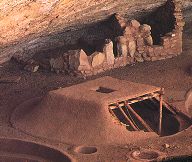 Log sections were added to span the distance from the beams to the earth and covered in poles, sticks and mud. A basin in the floor served as a fire pit, used for cooking and heating. Since most of the structure was above ground, there may have been many variations in size and shape which are no longer apparent. Soon the Anasazi were building arcs of multi-room additions around their pit houses. Later, it became fashiohable to move into the outer storage rooms. The pit gradually became identified with the past and the ancestors, a return to traditional ways. By the middle of the eighth century , pit houses were no longer used for storage but occupied the center of pueblos throughout the southwest; by the millenium, the pit house is designed on a bigger scale and surrounded by multi-storied dwellings.(Mesa Verde pit house photo courtesy of Time Life Books,The Mound Builders & Cliff Dwellers, 1992)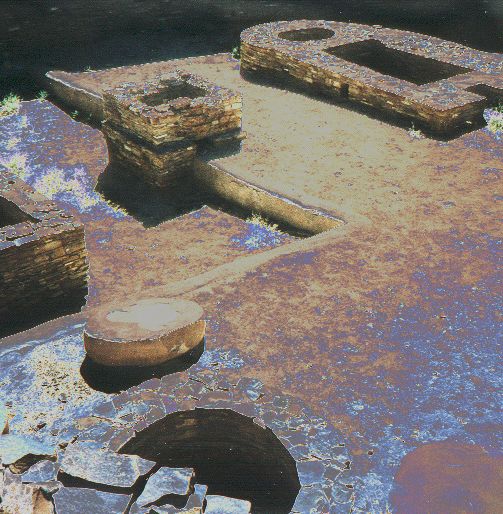
The floor of the Great Kiva in Chetro Ketl
Two of the four masonry-lined pits used for roof support posts; when they were excavated, one of the pits still held a post 26 1/2 " thick, as well as offerings of turquoise chips in leather bags. The large sandstone disk was used as a footing for the post. The square structure is a firebox.
Niches in the outer walls held strings of stone and shell beads and were then sealed with masonry.